Brand
Why Brand Consistency in Photography Matters More Than Trending Aesthetics
Feb 18, 2026
4 min read
Business
How We Price Our Work and Why We're Fully Transparent About It In Every Project
Feb 10, 2026
5 min read
Studio strobes are versatile. But natural light, properly understood and controlled, produces images that feel lived-in in a way flash rarely matches.
CATEGORY
Studio Tips
DATE
READ TIME
4 min read
The argument for artificial light in commercial photography is easy to make. Strobes are consistent. They do not change between 9am and 11am. They do not require you to wait for a cloud to pass. They do not go behind a building at 2 in the afternoon and leave you with flat, unusable light for the rest of the day. For certain kinds of commercial work, catalogue photography, controlled product shots, and anything requiring absolute consistency across hundreds of frames, artificial light is the correct tool.
But for the majority of the editorial, fashion, and brand work we produce, we choose available light. Not as a constraint, and not as a stylistic affectation. As a deliberate decision based on what natural light offers that artificial light cannot replicate.
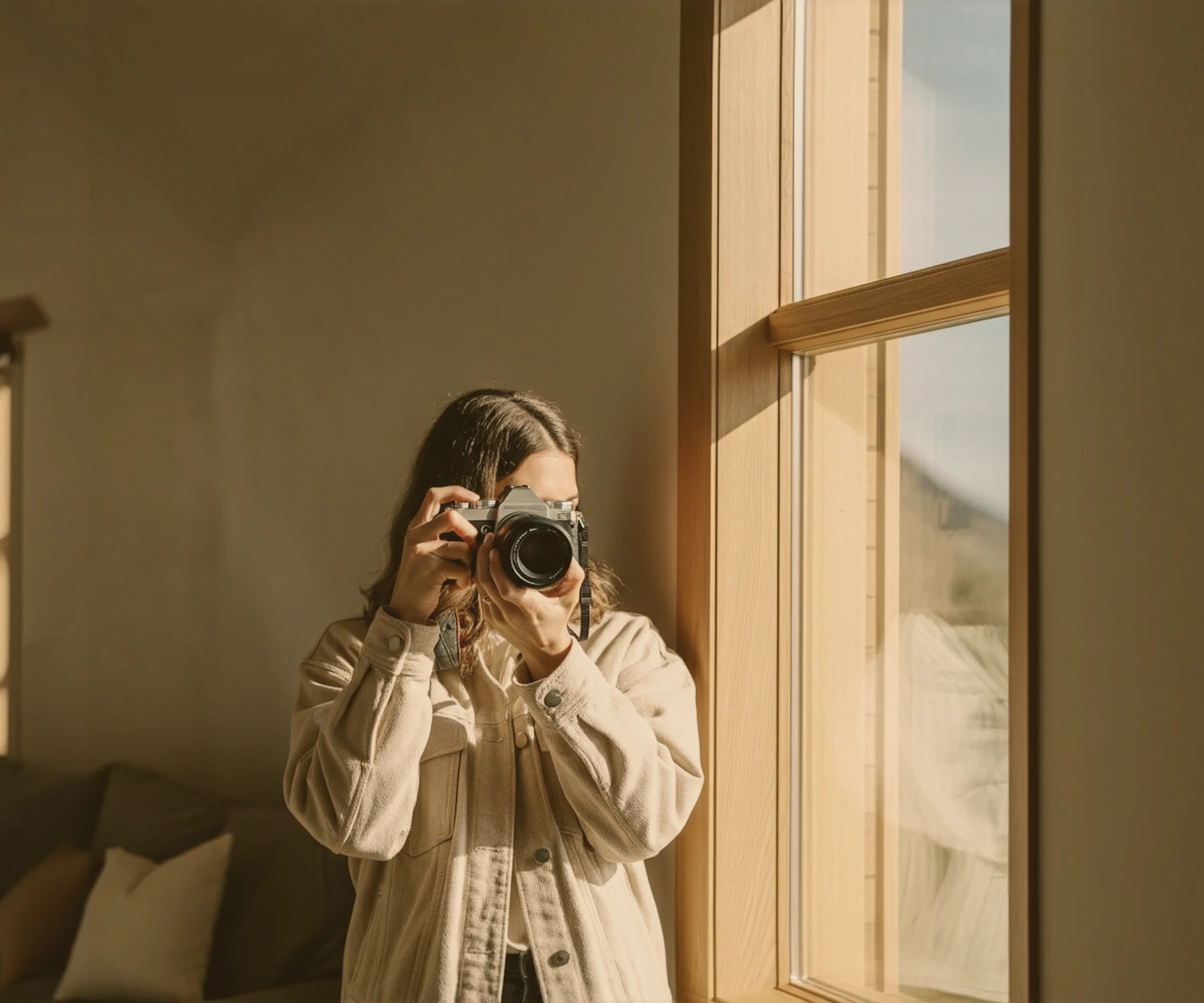
Natural light has a spectral complexity that no artificial source has yet matched. It contains the full visible spectrum in varying proportions depending on time of day, atmospheric conditions, and the surfaces it has bounced off before reaching the subject. This spectral richness is what gives skin photographed in natural light its depth and variability, the way color shifts across a face, the way shadows carry warmth, and the way a window creates a highlight that has direction and character.
Artificial light, even the most sophisticated studio flash, produces light from a point source or modified point source. The shadow quality, the way it wraps around form, and the spectral character of the highlights are all determined by the modifier you use. You can approximate many natural light conditions. You cannot replicate the specific quality of late afternoon light falling through a dusty east facing window in an old building. That light is irreducible. It belongs to that moment in that space.
This is not a romantic argument. It has direct practical consequences for the images we make. Photographs shot in extraordinary natural light have a presence that is difficult to manufacture, and audiences respond to it, often without knowing why.
"Flash is precise. Natural light is honest. For most of the work we want to make, honesty is the more difficult and more valuable quality."
Working with natural light is not passive. It requires active management. We arrive at locations before the shoot window to observe how the light moves and changes. We track which windows are useful at which times, where the fill is coming from, when the direct sun will create problems and when it will create opportunities.
Diffusion and reflection are the primary tools. A large white foam board, a silk diffuser across a window, or simply positioning the subject to face an open sky rather than direct sun, these basic interventions can radically transform the quality of available light. We do not carry large artificial kits to available light shoots, but we always carry reflectors, diffusion material, and the knowledge of how to use them.
Time of day is the largest variable we manage. Golden hour produces light with specific qualities that work for certain projects and are completely wrong for others. Overcast days produce flat, even light that many photographers dismiss but that we find enormously useful for product and fashion work where shadow control is critical. The ability to read what a given quality of light can and cannot do, and to match that against the requirements of the brief, is a core professional skill.
The remaining 20% of our work is shot with artificial light, and we are equally committed to it when the project requires it. High volume product photography where every frame must match identically requires strobes. Night shoots or interior scenes where the ambient light is unworkable require strobes. Projects where the creative direction specifically calls for the graphic, controlled quality that flash produces require strobes. The tool should serve the brief. We are not ideologically committed to either approach.
We also mix natural and artificial light regularly. A key light from a strobe combined with natural fill, or the reverse, available light from a window supplemented with a very low powered bounce to open shadows, allows us to make decisions at a level of precision that neither approach alone would permit.
There is a less discussed reason to prefer natural light for work involving human subjects, its effect on performance. Working in a studio with large strobes firing regularly is a particular kind of experience, clinical, technical, and separated from the real world. For some talent, especially those accustomed to it, this is neutral or even helpful. For non professional subjects and many fashion models, it is an environment that suppresses rather than reveals.
Natural light environments, rooms, streets, and outdoor spaces, are familiar. The body relaxes in them. The performance state that studio shoots can induce is much less likely. When we are choosing between a studio strobe setup and a good available light location, the talent's likely experience of each environment is a factor in our decision. For portraiture and for work involving real people, that factor carries significant weight.
Our available light kit is deliberately minimal. Reflectors in silver and white. A 5 in 1 reflector that includes a diffusion panel. Gaffer tape for temporarily diffusing windows or managing reflections. Occasionally a small LED panel for a fill touch in very low light situations. The small kit forces us to work with the light rather than override it, and that constraint produces better decisions than the freedom to solve everything with another light stand.